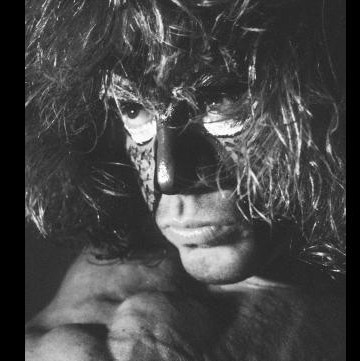
“Kill any and all resistance” that interferes with life’s purpose. The Ultimate Warrior was a man with a purpose unregulated by any regular sense of understanding. He was driven to be something larger than life itself.
He understood that potential was more than a word or a warm feeling inside. It was a very real idea that exists within all of us, one that we can tap into to reach our true selves.
He believed that you can shape your reality around the ideal version of yourself that you see within. It can happen, it can happen. You just have to put in the work to see it through.
Born in 1959 as James Brian Hellwig in Crawfordsville, Indiana, about 50 miles northwest of Indianapolis, he was the oldest of five children and was raised by his mother after his father left when he was 12.
He described himself as a “small, insecure kid who wasn’t very athletic.” But even then, Jim knew he wanted to be a part of something great and to have the opportunity to prove himself to those who ever doubted him.
Eventually, he discovered the weight room and, as he described it, he “made friends with the weight bench.” He would use this to further himself into a successful bodybuilding career that produced impressive results.
Eventually, Jim would be noticed for his great size and strength and would be trained by Red Bastien and Rick Bassman. He, along with fellow trainee Steve Borden (who later became Sting), formed a tag team known as the Freedom Fighters. This would help him gain some traction within the industry alongside his partner.
Eventually, when he and Steve arrived in the Universal Wrestling Federation, they would take on the name of the Blade Runners, which was created by promoter Bill Watts as a parody of the Road Warriors.
Here, they gained much more notoriety than they ever had before, eventually facing The Fabulous Freebirds at the “Superdome Extravaganza” in Louisiana. Ultimately, however, the match would end in defeat.
Eventually, Hellwig would leave the UWF, and the Blade Runners would be disbanded. Jim would briefly spend time in WCCW (1986–1987) as the Dingo Warrior. He adopted this name because a member of the WCCW locker room remarked that he looked like “a Warrior.”
Eventually, the Dingo Warrior would successfully claim the WCWA Texas Heavyweight Championship from Bob Bradley on February 2, 1987. He successfully defended the title against Bradley but would ultimately leave the company, resulting in the championship being held up in April of that year.
He shortly returned but soon left once again, vacating the title as he departed for the WWF. He made his final WCCW appearance in June 1987.
He knew that the WWF was exactly where he needed to be to thrive, as he was exactly the kind of talent the federation was looking for at the time. He was loud, brash, and colorful—everything that era represented.
He would eventually gain the name “Ultimate Warrior,” as it was felt there was no need for another simple Warrior when there was already “The Modern Day Warrior” and “The Road Warriors.”
From then on, he quickly gained popularity within the company and with the fans, as his energetic and motivating style resonated with many.
Less than a year after his debut, he won the WWF Intercontinental Championship by defeating The Honky Tonk Man in a 27-second squash match at SummerSlam 1988. This decision went over well, as the fan reaction to Warrior at this time was extremely positive.
After a year of successfully defending the title against many opponents and continuing to build the legend of the Ultimate Warrior, he faced the greatest challenge of his career up to that point. It was the “Ultimate Challenge.”
Warrior was receiving a massive push from the moment he won the Intercontinental Championship at SummerSlam up to his most iconic match at WrestleMania VI against the Immortal Hulk Hogan.
Hogan, up to that point, was easily the biggest and most identifiable star in professional wrestling history. His persona also shared many characteristics with Warrior, as he was a loud, brash, and colorful character with a large fan base.
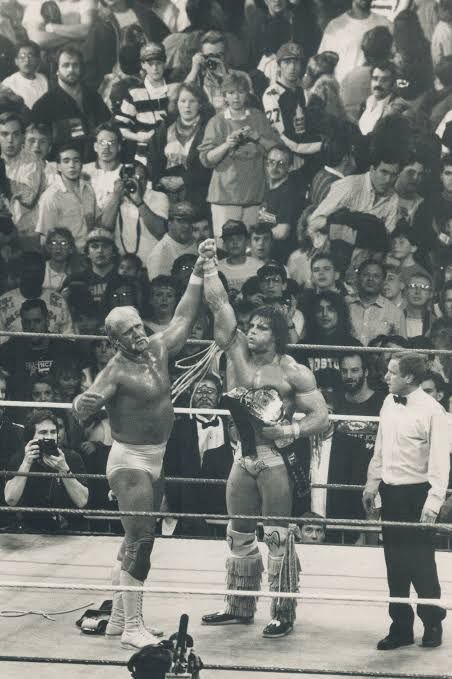
After a meeting between the two at the 1990 Royal Rumble, Warrior was named Hogan’s opponent at WrestleMania VI at the SkyDome in Toronto. It was “The Ultimate Challenge.” Two of the biggest stars in the company would finally meet one-on-one, with both titles on the line, as Hogan was the reigning WWF Champion.
The two received a thunderous response from the crowd as they made their entrances for the match. But as popular as Hogan was at the time, the fans seemed ready for a change of pace and a new face to take over the reins.
The Ultimate Warrior represented the pure, unfiltered spirit of many wrestling fans during that era. Although very cryptic at times and difficult to grasp, his energy, which represented absolute, unadulterated strength, resonated with many fans around the globe.
He represented something greater than anything we can imagine, something larger than life. But just like potential, he represented something that all of us can strive for.
The Ultimate Warrior would go on to defeat Hulk Hogan to win the WWF Championship in the biggest match of his career. It helped solidify his legacy within the wrestling world and cement his place in popular culture forever.
Warrior lived his life as a “One Warrior Nation.” He believed in destiny, and he saw that a man can truly achieve immortality if what he does in life carries enough weight to resonate with his fellow man for the greater good.
Always believe, and always follow your potential, even if that’s all you have left to believe in.
“Every man’s heart one day beats its final beat. His lungs breathe a final breath. And if what that man did in his life makes the blood pulse through the body of others and makes them believe deeper in something larger than life, then his essence, his spirit, will be immortalized by the storytellers, by the loyalty, by the memory of those who honor him. And the spirit of the Ultimate Warrior will run forever!”
— Jim Hellwig, The Ultimate Warrior
 realkensei
Leave a comment